· 6 min read
Introducing WhatCameUp: every call heard, every question answered
Most calls are recorded and never heard. What that costs sales and support teams, with the figures, and how WhatCameUp answers your own questions for every call.
Ask a sales manager why deals stalled last month, or a support lead why customers called, and you will usually get an honest guess. The real answer was said out loud, on the phone, hundreds of times. It is sitting in the recordings, and hardly anyone listens to them.
We built WhatCameUp to change that. This post looks at the problem first, with the best figures we could find, and then at what WhatCameUp does about it.
The phone is still where the important conversations happen
Chat and self-service have taken many of the simple questions. What is left for the phone is the part that matters most: the purchase, the booking, the complaint, the problem that did not fit a form.
- Gartner found that customers fully resolve only 14% of their service issues in self-service, and only 36% of the issues they themselves describe as very simple. That leaves most problems for a person to solve.
- In a 2024 survey of 3,661 US adults, published in Health Affairs Scholar, 56.4% said phone calls were their main way of booking medical appointments.
Most calls are never heard
Recording calls is easy. Listening to them is not. A team that takes 100 calls a day, at five minutes each, records more than eight hours of conversation every day. Hearing it once would be a full-time job, before anyone wrote down a single note.
So teams sample. Analysts at ISG Research put the share of contact centre interactions typically scored for quality at "as little as 1% to 3% of the total". When Call Centre Helper polled its readers in 2016, 68% of the contact centres that answered said they evaluate 2% or fewer of their interactions.
At 2%, a team taking 100 calls a day hears two of them. The other 98 are recorded, stored and never heard.
In smaller teams without anyone in charge of quality, the call a manager hears is often the one a customer complained about: the call that already went wrong.
What goes unheard costs customers
When nobody listens, two things stay out of sight: the calls that never reached anyone, and the patterns across the calls that did.
Calls nobody answered. In England's 2026 GP Patient Survey, with more than 650,000 responses, only 56.9% of patients said it was easy to contact their GP practice on the phone. And callers rarely leave a message instead: in a 2016 study by Moneypenny, a company that answers phones for small businesses, 69% of callers who reached voicemail hung up without leaving one.
Calls that went unanswered or waited too long. CDK Global surveyed more than 2,000 car service customers. Those whose call to the dealership went unanswered gave a Net Promoter Score of 26.7. Those put on hold, who waited more than eight minutes on average, gave 39.7. The average that year was 59, and 40% of service customers had this kind of experience.
Customers whose call went unanswered scored the dealership 26.7, against an average of 59.
Patterns nobody adds up. Which product people keep asking about, which objection loses the sale, which promise brings customers back on the phone a week later. Each is said on a call, again and again, and rarely makes it into a report.
Coaching starts from real calls
The calls that are heard do a lot of good. In a study of 2,327 telephone operators published in Personnel Psychology, "the majority of coaching consisted of individualized feedback based on monitoring of calls", and "the amount of coaching that an employee received each month predicted objective performance improvements over time".
The catch has always been the listening. If every call is heard, any call can be coached from, and the patterns add up by themselves.
What WhatCameUp does
WhatCameUp listens to every call you bring in. Each one is transcribed, summarised, and asked the questions your business cares about, with every answer pointing to the moment in the call it came from.
Bring calls in the way you already keep them
Most phone systems already save their recordings to cloud storage. Connect that bucket with read-only keys, and new recordings are imported every 15 minutes. You can also upload files, or send them from your own systems through the API. Stereo recordings tell the agent and the customer apart by channel, and mono recordings by voice. Calls can be in more than 30 languages, and summaries are written in the language your team works in.
Calls are grouped into collections, such as a sales line, customer care or website callbacks, each with its own questions and settings.
Ask the questions your business runs on
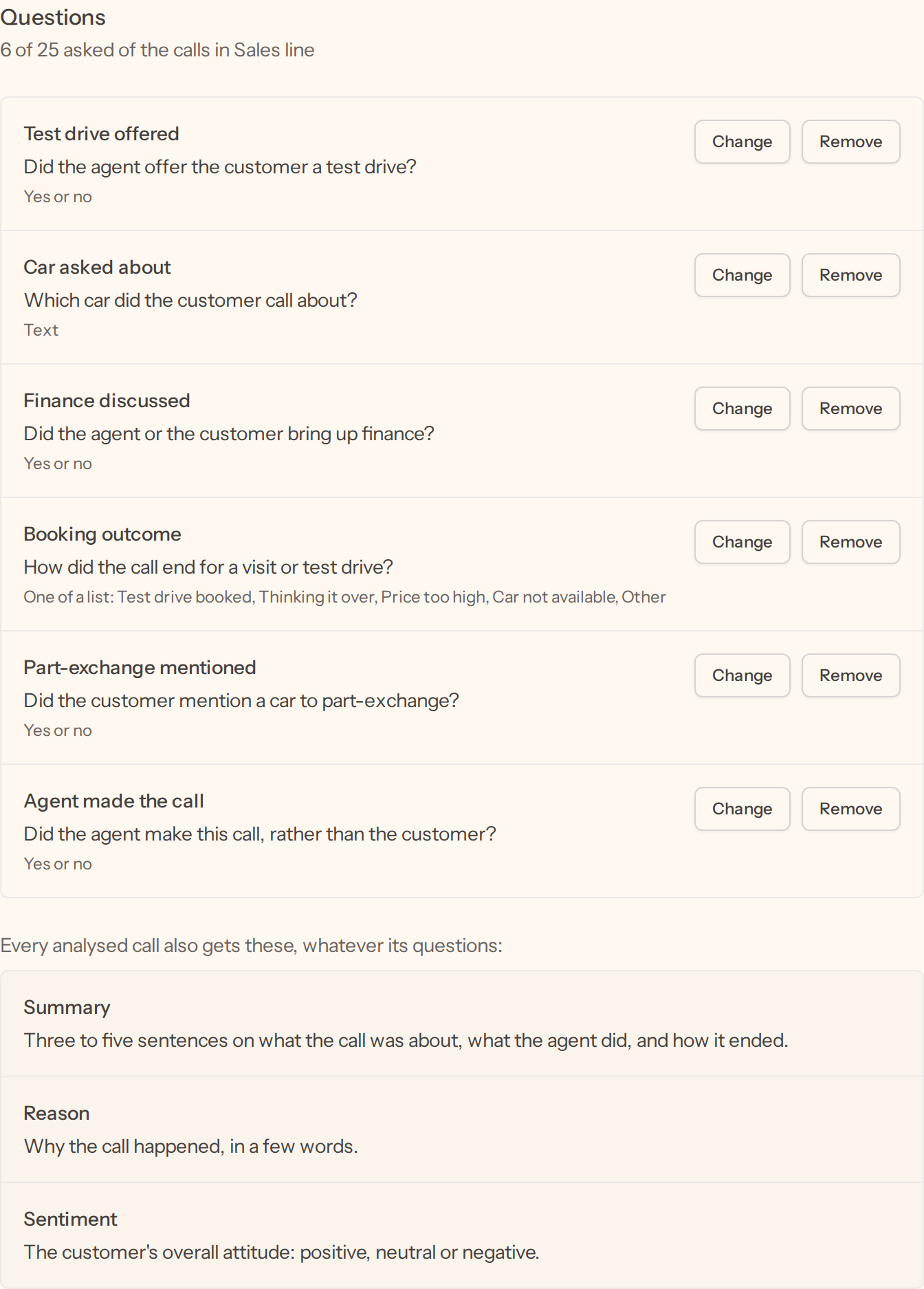
A generic score does not tell a car dealer whether a test drive was offered, or a clinic whether the caller booked. In WhatCameUp you write the questions, with yes or no, a number, a choice from a list, or free text for an answer. Describe what you want to know in a sentence or two, and the assistant drafts them. Sales and support collections start with a few questions for their kind of calls, and a question added later can be answered for the calls you already have. More in Questions.
Every answer shows where it came from
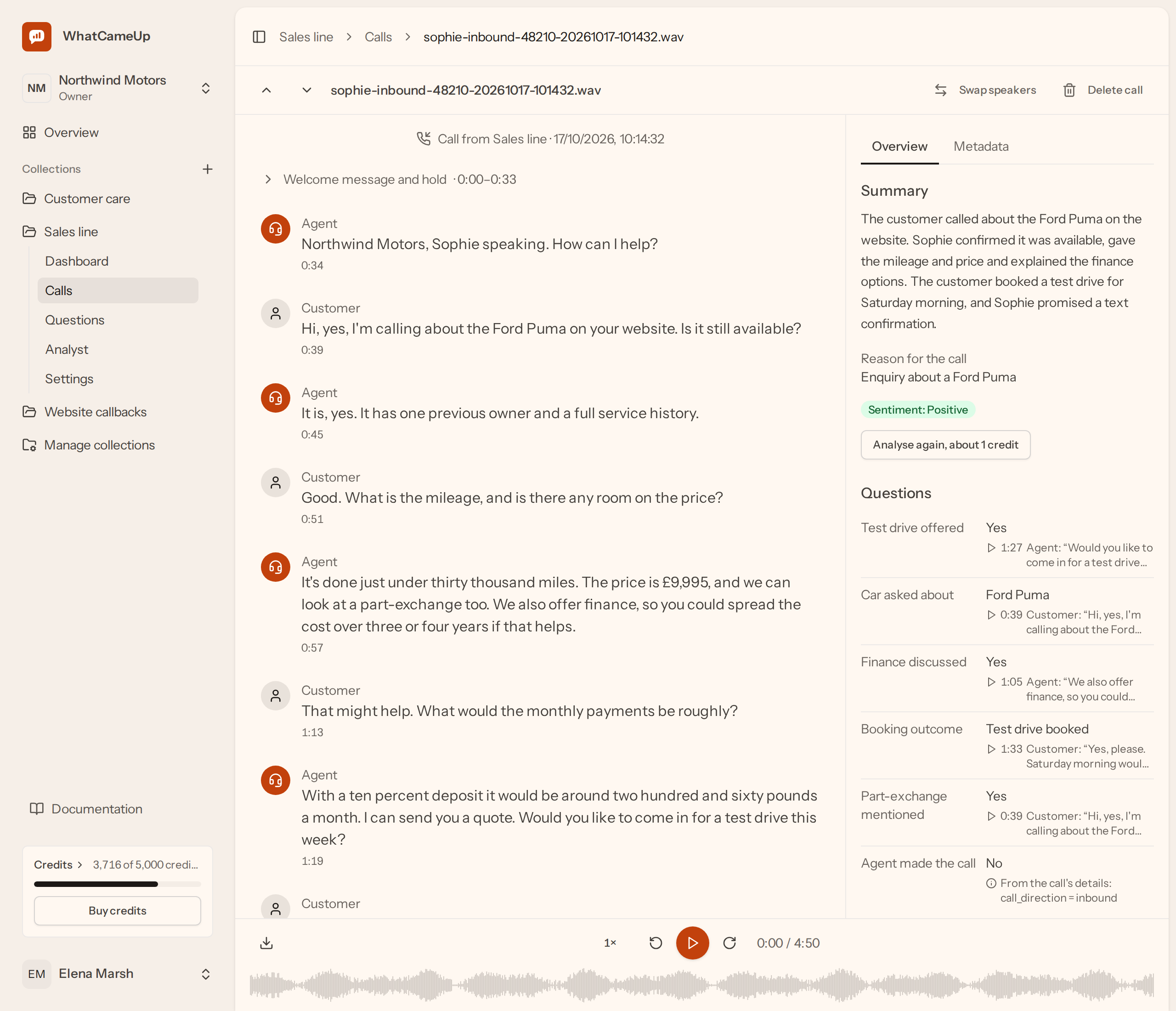
Each answer quotes the line it came from, with its time in the call. Click it and the call plays from there. Nobody has to take the AI's word for it, and coaching can start from the exact moment.
See the patterns across every call
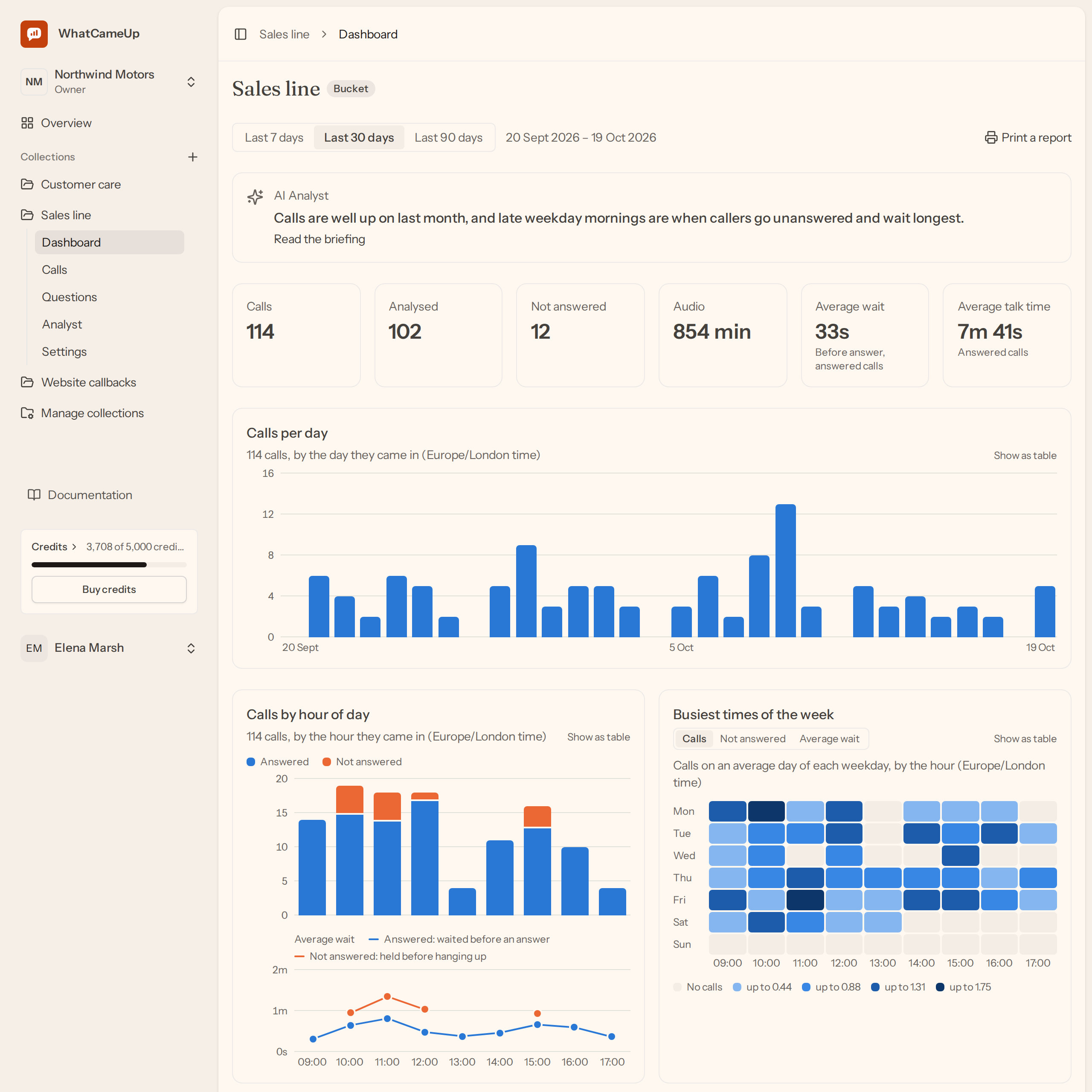
Each collection's dashboard adds its calls up over the last 7, 30 or 90 days: how many came in, how many nobody answered, how long callers waited, the busiest hours of the week, how customers felt, and how each question was answered, with a click through to the calls behind every number. The unanswered calls and long waits from earlier stop being invisible, hour by hour, so you can see when more people need to be on the phones.
Each week, on Monday morning unless you choose another day, the team gets the week's report by email, with a PDF to pass on. Any list of calls exports to Excel or CSV, and results can be written back next to each recording in your own bucket. More in Dashboards, reports and exports.
An analyst that tells you what changed
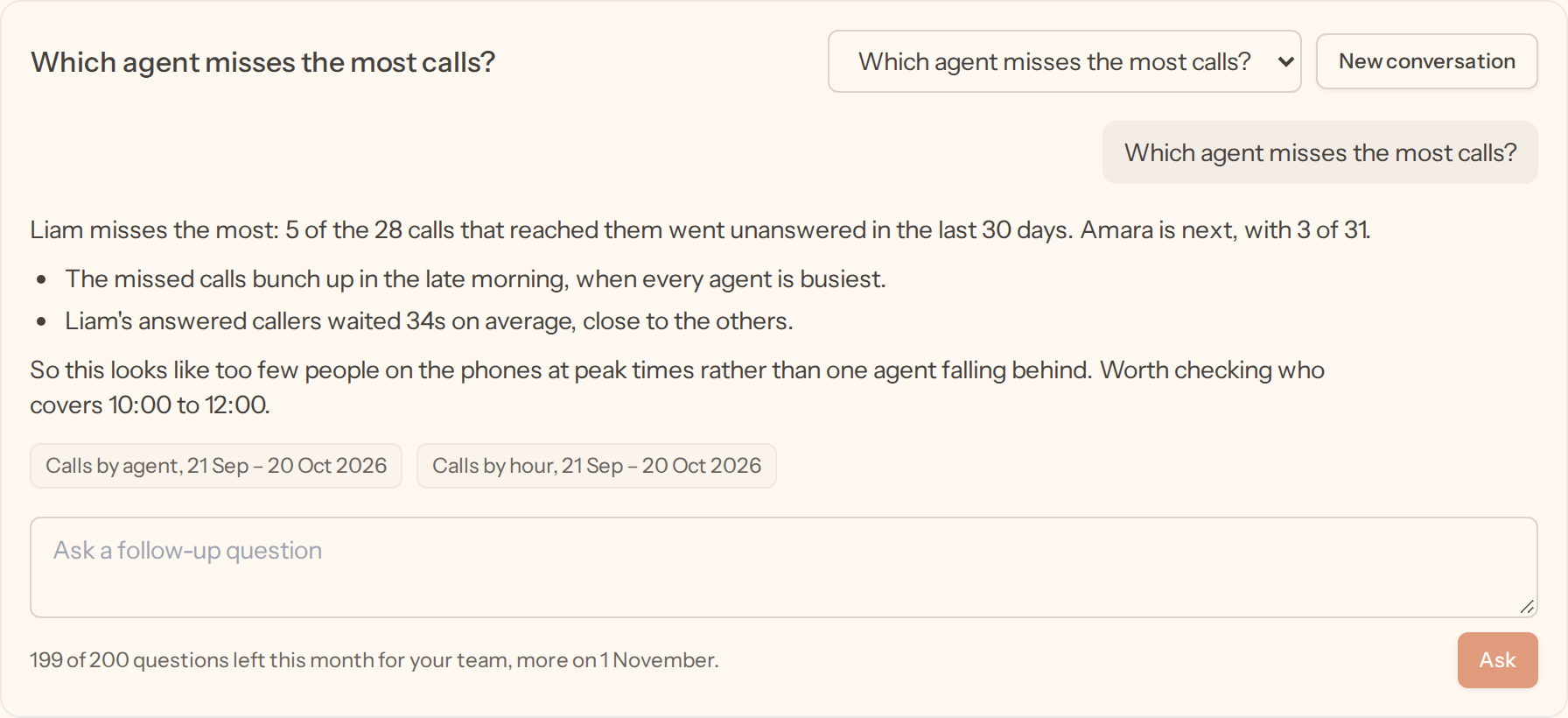
Hire an AI Analyst for a collection, and it briefs your team on what changed against the period before and what deserves attention. Then ask it follow-up questions in plain words.
Your recordings stay yours
Recordings you bring from your bucket stay there, and WhatCameUp never deletes or changes your files. Audio sent for transcription is deleted by the provider as soon as each call is done. You choose how long transcripts and summaries are kept, while their figures stay for your reports, and a manager can delete everything WhatCameUp holds about a single call in one step, for example when a customer asks to be forgotten.
How to start
You pay by the minute of call audio: one credit is one minute, transcribed and analysed. Every new team starts with free credits, with no card needed, and the plans are on the pricing page.
A good first test: take a week of calls from one line, write five questions you wish you could answer for every call, and see what came up. Getting started walks through it step by step.
The pictures in this post show Northwind Motors, a made-up used-car dealer from our documentation, not a customer.
Sources
- Gartner, "Gartner Survey Finds Only 14% of Customer Service Issues Are Fully Resolved in Self-Service", press release, August 2024.
- Simon F. Haeder and Wendy Y. Xu, "What methods do patients use to schedule medical appointments?", Health Affairs Scholar 3(4), April 2025. Online survey of 3,661 US adults, October and November 2024.
- ISG Research, "Contact Center Quality Processes Must Modernize for the Digital Era", July 2022.
- Call Centre Helper, reader poll on the share of interactions evaluated for quality, November 2016. 113 responses.
- Ipsos for NHS England, "2026 GP Patient Survey results released", July 2026.
- Moneypenny, small business call report, November 2016. A survey of 300 micro businesses and call data from 10,000 businesses.
- CDK Global, "How unanswered calls hurt service department satisfaction", February 2025. A survey of more than 2,000 car service customers.
- Xiangmin Liu and Rosemary Batt, "How Supervisors Influence Performance", Personnel Psychology 63(2), 2010.