· 6 min read
Score your AI voice agent and your people on the same questions
AI voice agents now answer calls next to people, and few teams check either closely. Why that matters, with the figures, and how to ask both your own questions in WhatCameUp.
More calls are now answered by an AI voice agent. It books the appointment, takes the order or answers the question, and passes the rest to a person. The platform behind it can count its calls and their minutes. What it can't tell you is whether the bot offered the test drive, quoted the right price, or left the caller wanting a person. For most teams, the same is true of their people's calls.
WhatCameUp now takes the transcript of a call instead of its recording. So the calls your AI agent takes and the calls your people take can be asked the same questions, and compared. This post looks at why that matters, with the figures we could find, and then at how it works.
AI voice agents are joining the phones
In a Gartner survey of 187 customer service leaders in the summer of 2024, 85% said they would explore or pilot customer-facing conversational generative AI in 2025. Voice was part of it: 44% had explored a generative AI voice bot that year, 11% were piloting one, and 5% already had one in use.
The people are staying too. Gartner predicts that by 2027, half of the organisations that expected to cut their customer service staff significantly will have abandoned those plans. For years to come, many teams will have a bot and people answering the same phone line.
Customers are watching how the bot does
Customers are not sold yet. In a Gartner survey of 5,728 customers, run in December 2023, 64% said they would prefer that companies didn't use AI for customer service. 53% would consider switching to a competitor if they found out a company was going to. Their top worry was that it would be harder to reach a person, and more than four in ten worried that the AI would give wrong answers.
You answer for what your bot says
In February 2024, a Canadian tribunal decided Moffatt v. Air Canada. After a death in his family, a passenger had asked the airline's website chatbot about bereavement fares. It told him he could buy his tickets and claim the discount afterwards, which the airline's policy did not allow. Air Canada argued, in effect, that the chatbot was responsible for its own actions. The tribunal called that "a remarkable submission" and ordered the airline to pay him the difference in fare.
"It should be obvious to Air Canada that it is responsible for all the information on its website."
That was a chatbot on a website, but the same holds on the phone: what a voice agent promises, the business has promised.
Nobody listens to the bot's calls either
People's calls are rarely heard. Analysts at ISG Research put the share of contact centre interactions typically scored for quality at "as little as 1% to 3% of the total". A bot's calls usually have nobody assigned to them at all. It may be tested well before it goes live, but the calls that count are the ones real customers make afterwards, hundreds a day, at any hour.
The same questions for the bot and your people
The fair way to judge a bot is the way you would judge a person: by what happened on its calls. Write down the questions your business runs on, and ask them of every call, whoever took it. For example:
- Did the caller get what they called for?
- Was an appointment booked?
- Did the caller ask to speak to a person?
- Did the agent promise anything, such as a price, a refund or a callback?
Asked of the bot's calls and your people's calls in the same weeks, the answers compare like for like. When the two differ, every answer quotes the line it came from, so you can read why.
The answers also show which calls to give the bot. If it books appointments as often as your people do but loses most callers who want to change one, you know where to draw the line.
How it works in WhatCameUp
Send the transcript, not the audio
An AI voice agent already has the transcript of every call it takes, and many phone systems make one too. Send it to a WhatCameUp collection through the API, line by line, with who spoke and when:
POST https://whatcameup.com/api/v1/transcripts

{
  "unique_call_id": "48211",
  "metadata": {"handled_by": "ai"},
  "transcript": [
    {
      "speaker": "agent",
      "start_ms": 0,
      "end_ms": 3200,
      "text": "Northwind Motors, how can I help?"
    },
    {
      "speaker": "customer",
      "start_ms": 3600,
      "end_ms": 7000,
      "text": "I'd like to book a service."
    }
  ]
}
Your AI agent speaks as the agent. If your voice platform sends each call's transcript to a web address when the call ends, a few lines of code there can pass it on in this shape. Each call is then summarised, its reason and the customer's mood noted, and your questions answered, as for a recording. Every answer quotes its line, and clicking it takes you to that line in the transcript. A call in which the customer never spoke is marked as not answered.
Nothing is transcribed, so a transcript costs only its analysis: 0.2 credit a minute of the call, against one credit a minute for a recording. The details are in the API guide.
Put the bot's calls and your people's in one collection
Questions belong to a collection, so send both kinds of call to the same one. Your people's calls go to it through the API too, as recordings, or as transcripts if your phone system makes them. Tag each call with who took it, such as handled_by above, and turn on Take metadata sent through the API in the collection's settings.
See them side by side
Ask the collection's AI Analyst how the AI agent compares with your people. It groups the calls by a field of their metadata, such as handled_by, and for each group gives how many calls there were, in how many the customer was unhappy, and how each yes-or-no and list question was answered. Each reply links to the calls behind it.
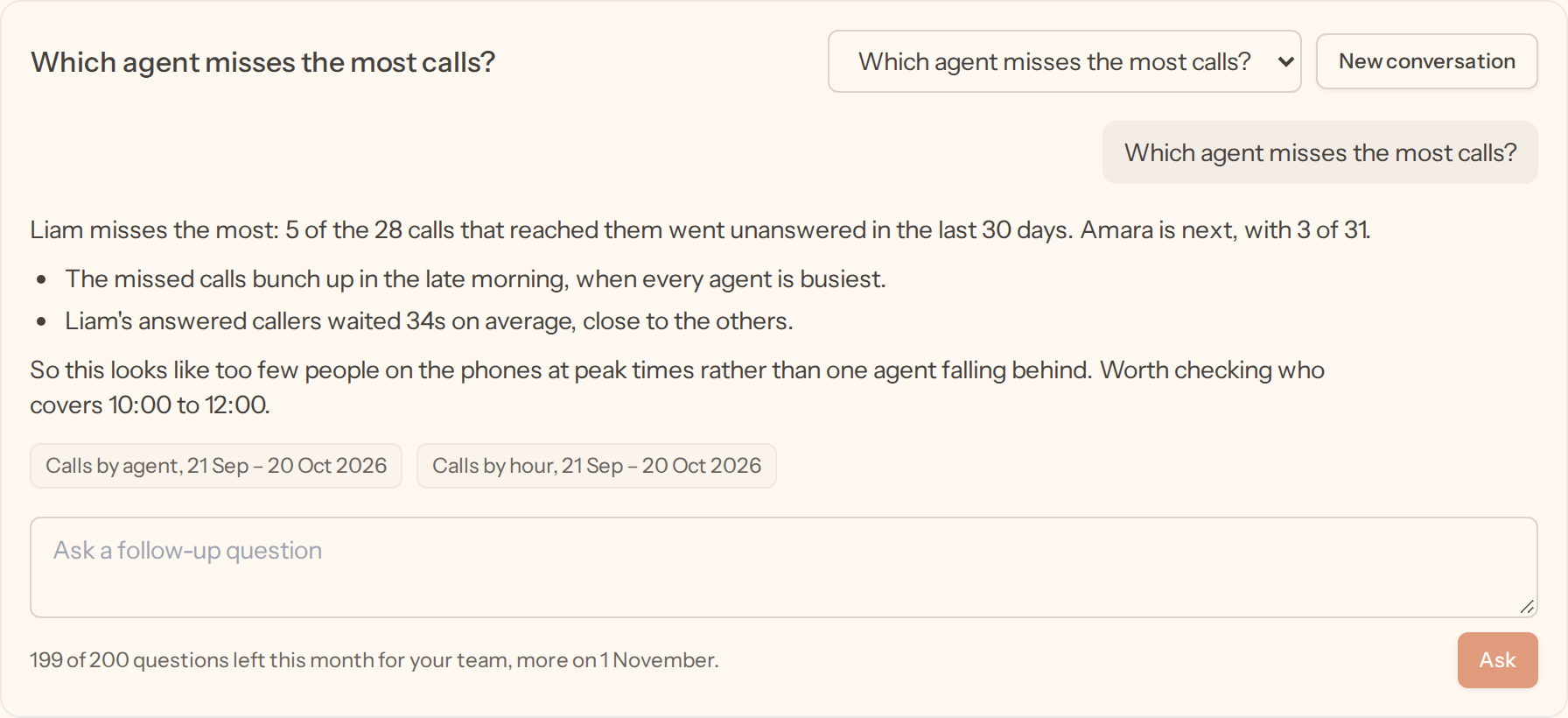
Or export the calls to Excel. Each row has the call's answers and its metadata, so a pivot table splits any answer by handled_by.
How to start
Create a collection whose calls come in through the API, write the questions you would ask of any call, and create an API token in the collection's settings. Then send a week of your AI agent's calls and a week of your people's, and compare. Every new team starts with free credits, with no card needed, and at 0.2 credit a minute they go five times as far on transcripts. Getting started walks through the rest.
The picture in this post shows Northwind Motors, a made-up used-car dealer from our documentation, not a customer.
Sources
- Gartner, "Gartner Survey Reveals 85% of Customer Service Leaders Will Explore or Pilot Customer-Facing Conversational GenAI in 2025", press release, December 2024. A survey of 187 customer service and support leaders, July and August 2024. The voice bot figures from the same survey are as reported by CX Today.
- Gartner, "Gartner Predicts 50% of Organizations Will Abandon Plans to Reduce Customer Service Workforce Due to AI", press release, June 2025.
- Gartner, "Gartner Survey Finds 64% of Customers Would Prefer That Companies Didn't Use AI For Customer Service", press release, July 2024. A survey of 5,728 customers, December 2023.
- Moffatt v. Air Canada, 2024 BCCRT 149, Civil Resolution Tribunal of British Columbia, February 2024.
- ISG Research, "Contact Center Quality Processes Must Modernize for the Digital Era", July 2022.